1. How are your circumstances in Tehachapi at the current time?
Answer: I would describe them as siege-like. There are threats that my car will be blindsided at a stop sign or traffic light if I attempt to travel anywhere.
Further afield, it is reported that the OIG Hotline has been prevented from forwarding appropriate documentation to my legal representation today -- a deficit I hope I have now corrected.
Beyond this, I would like to have an assurance that the Foundation is intact and that its assets are currently safe from misappropriation -- and robustly supported against misappropriation in the future.
2. What about the Supreme Court? Is the Supreme Court answering primarily to the FBI at this time?
Answer: I think the Supreme Court supports the sovereignty of the United States, and I think the Honorable Justices understand how critical their decision-making will be for Americans' freedoms in perpetuity.
Do I believe the FBI is wrongfully pressuring the Supreme Court? I do.
3. What about suggestions that certain political figures are trying to reach out to you at this time?
Answer: I think political algorithms are reaching out to me at this time through texts to my phone and this sort of AI-generated "communication," which isn't communication at all. Do I think there's some testing of my willingness to engage in dialogue? Clearly, there is.
4. What are your views about this?
Answer: You cannot negotiate with someone who wants your life. The FBI is really behind all of this so-called "outreach," and the FBI has made itself very clear that it has first-degree murder foremost in the agency's mind. Insightful people cannot become confused on this point.
There are times when diplomacy is profoundly important. But murderers and diplomats are fundamentally opposed in their aims. War and peace are not comparable outcomes.
5. You have recently spoken a vow to uphold the United States.
Answer: I have, yes.
6. May I ask the contents of that vow?
Answer: Yes, certainly. I am currently on leave from the Foundation I have specified for the support of United States sovereignty, it is important to state.
These are the words I spoke:
I do solemnly swear that I will uphold the sovereignty and wellbeing of the United States with my every effort, initiative, and allocation pertaining to the Foundation and otherwise; that I will support the safety, self-determination and future of the American people, and the sustainability of the environment on which all our freedoms rely; that I will support and defend the Constitution of the United States against all enemies, foreign and domestic; that I will bear true faith and allegiance to the same; that I take this obligation freely, without any mental reservation or purpose of evasion; and that I will well and faithfully discharge all duties associated with this promise. So help me God.
7. What does that vow mean to you, please?
Answer: It means that I have dedicated myself to the sovereignty of our nation and the sustainability on which that sovereignty depends.
And it means that if everyone else is caving into the winds and weather and turbulence of these times, I will still stand faithful to my vow to serve and to lead in every capacity possible.
8. Would you ever consider elected office?
Answer: Only if it were determined that I possessed no conflict of interest in serving the nation to my utmost.
Beyond this, I would want people to know that my style of leadership would ultimately involve partnerships with those who could assist us in transitioning to clean energy in a time frame that would be most meaningful for our future.
I wouldn't care about being re-elected, and I would explain to my constituents that I cared about them more than personal political ambitions.
Then I would ask for their help, their teamwork, their support, and their engagement on every level so that we could accomplish the changes that are most crucial for our sustained sovereignty.
Given our climate crisis, we need to partner with the right messengers and we need to enlist the entire public in a unified effort to make transformative changes on a clear timeline.
The alternatives are Draconian, and they will not manifest in some indeterminate future we cannot grasp. On the contrary, if we fail to re-approach this crisis, the horrific consequences of inaction will manifest quite rapidly.
9. What about the allegation that the public would never consent to such changes?
Answer: Change is coming for us, whether we consent to it or not.
The critical thing in reproaching this crisis point is to respect the public enough to educate them about the most compelling truths we can convey about the environment, and also to provide the right messengers so that the public as a whole can gain understanding.
No one spokesperson can be heard by everyone, and this simply relates to the fact that we all live within different social frameworks that allow certain communications and inhibit others. So, we need a broad array of messengers, including those from the United States military, to disclose to the public the seriousness of our circumstances and to ask for their help in meeting a whole panoply of timely goals.
The necessity of environmental sustainability needs to be de-politicized, and we can accomplish this effectively by making the right partnerships in this effort.
10. Why is environmental sustainability so central to United States sovereignty?
Answer: For those who have never studied Easter Island, the example is illuminating.
In that case, deforestation led to soil erosion, which led to a collapse of the food supply, which was accompanied by enslavement of part of the population, all of which led to decimation of the population as a whole.
The Earth is our island, and our expert stewardship of the environment is necessary for all of our most meaningful freedoms in the context of a worthy and thriving civilization.
11. In other words, we cannot manifest our freedoms without also fulfilling our responsibilities.
Answer: Exactly so.
12. But is this paradigm shift possible for us in realistic terms?
Answer: I wouldn't be here if it weren't possible for us. Yes, we can achieve it.
13. Will you please keep in close communication with us, given the current circumstances?
Answer: Of course.
14. Thank you for speaking with us this afternoon.
Answer: You are most welcome.

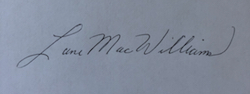
Lane MacWilliams, aka Carol Elaine Von Herzen