While I have asked for a measure of consensus among American leaders on the issue of data centers, there is no consensus. Proponents of data centers appear to suggest that global risks from Russia/Iran are too great if there is notable, coordinated opposition to data centers within the United States.
Yet, to what extent, having constructed the architecture of our own totalitarian control through the disinformation processed by data centers, will such a victory be Pyrrhic? If we allow pervasive construction of data centers to proceed, is it because we are harboring an illusion that worse outcomes can be avoided?
Do we think that widespread environmental harms by Russia/Iran will be withheld because of Vladimir Putin's compassion for the West? His humanitarian leanings? His commitment to dialogue and cooperation?
Such reasoning is disordered, its hopes illusory.
If we fail to ensure that the architecture of society upholds our human dignity now, then we fail to uphold it for the future as well.
Fundamentally, we need to communicate to Russia/Iran that wide scale harm to American territory or the global environment will not result in the control Vladimir Putin seeks.
Rather, it will lead to his infamy and disgrace within the community of nations, alongside his sure condemnation by history.
The data centers need to be separated from the scourges of knowingly falsified law enforcement reporting, AI-generated disinformation, forced human trafficking, and systemic defamation in order for American communities to begin to consider their environmental impacts regarding water use, electricity consumption, and other sustainability concerns.
States are correct to resist the construction of data centers within their borders until we have reached widespread consensus that safeguards to long term human sovereignty have been reliably and consistently implemented prior to installation of these facilities.
Without a clear view of the inflection point that widespread installation of data centers represent, the goal of human sovereignty in the long term will be abandoned at this juncture.
I don't find that acceptable, and I don't believe our elected officials should find it tenable either.
The United States is capable of a much more worthy future if we insist on it together. It takes principled leadership, and this is what I want to see.
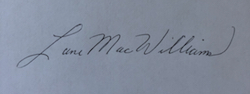
Lane MacWilliams
********************************************************************
1. What is your perspective on state pushback against the construction of data centers? Given that there is a push for new data centers across the country at this time, how are we to view the resistance of some states to their emergence?
Answer: I think it is most accurate for us to be thinking about data centers as installations, as opposed to construction projects, per se. They represent an alleged partnership between private industry and government, but few people grasp the genuine function of data centers, their purpose, their permanence, or their impact on America's future.
Some communities have organized citizen committees to investigate data centers in neighboring states, and these groups have found barbed wire, guard dogs, and fortified installations that are militaristic in nature.
When communities start asking questions, they find that their elected officials have signed non-disclosure agreements, ostensibly put forward by the private companies involved. In actuality, these are secrecy agreements that have been carefully worded to ensure as much confidentiality as possible regarding data centers' purposes.
And the problem is that secrecy agreements, once signed, cannot be undone.
So, suddenly the elected officials in a given part of the country cannot speak truthfully to their constituents regarding the greatest concerns pertaining to data centers.
2. Are data centers a functional Trojan Horse for AI, in the truest sense?
Answer: Given the fact that data centers are processing enormous amounts of disinformation, yes, we can consider them as Trojan Horses which presage a profound and complete control over American sovereignty on the basis of false documentation. AI-generated films co-opting the likeness of Americans, AI-generated audio co-opting the voices of Americans -- these modalities require tremendous data infrastructure regarding the creation, aggregation and dissemination of false material.
Complicating matters is the fact that this is not everything that data centers do. Some of data centers' functions are legitimate, without question. But legitimate and illegitimate purposes are intertwined so thoroughly as to represent the proverbial Gordion Knot for American society.
How do we untangle truth from lies within data centers that are designed to serve as impenetrable fortresses, indifferent to public objection?
3. Will there be some future time in which the knowingly falsified law enforcement reporting can be selectively removed from data centers?
Answer: Will there be a way for us to pull these individual threads out of the Gordion Knot and thus untie the whole problem? No, this is not a realistic aspiration.
We need to address the systems of knowingly falsified law enforcement reporting prior to the construction of the architecture of disinformation.
4. Are women and children being disproportionately targeted by AI-generated film, photos and audio created, aggregated and disseminated by data centers?
Answer: Yes, and I think there is widespread agreement on this point. Minority populations are also overrepresented among the victims of AI disinformation.
5. What about the placement of data centers within satellites, which has been discussed?
Answer: This alternative is even more dystopian, because the public would have no hope of seeing the means of the processing of false information being used against them.
6. What are the greatest dangers inherent in these installations?
Answer: The greatest dangers are that data centers will come to be necessary for a portion of legitimate societal functioning, but at the same time will come to represent a Ministry of Lies, wielded against a fearful public in perpetuity.
7. How likely is that outcome?
Answer: Right now? One hundred percent.
8. Who is actually directing the simultaneous installation of data centers across the United States at this time? Is this coming from the United States itself?
Answer: This is not a U.S. government initiative in its point of origin, no, although the United States has discussed these plans in detail. The primary international driver is Russia.
9. What do we need to do to ensure that data centers do not become a kind of structure of tyranny, in which our nation is harnessed to a confabulating AI autocracy?
Answer: We need to assess whether state governments have the ability to insist that falsified law enforcement reporting be excluded from projects within their borders. Do State Attorneys General have the ability to challenge the installation of data centers based on the knowledge that they are currently serving to create, aggregate and disseminate disinformation about the American public?
If so, then they have a critical role to play in the nation's insistence that our future governance not resign itself to falsehoods and defamation against its constituents.
State Governors should certainly be speaking to one another about their ability to join together in rejecting data centers as conduits for ongoing disinformation, and Governors' objections can assist the federal government in rejecting systems of knowingly falsified law enforcement reporting as well.
10. Do the FBI and its affiliates require knowingly falsified law enforcement reporting to accomplish their mission and objectives?
Answer: They do not require it, no.
They want to be able to lie about the public.
They do not need to be able to lie about the public.
And I will be the first to acknowledge that the mission and objectives of the FBI are exceptionally challenging.
But we cannot allow the agency to throw away the future sovereignty of the nation as a result of those challenges.
11. How late are we to this discussion in terms of the national discourse?
Answer: We're in the eleventh hour. But we still have the ability to reject knowingly falsified files about every American citizen, including minors. And we still have that obligation.
12. You were speaking recently about balance of powers as being critical to Americans' resilience regarding certain crises that could arise in the future. Do we need this balance between state and federal governance to robustly protect the interests of individual and national sovereignty?
Answer: We truly do. If the federal government were to come under undue pressure from external influences, then the states can offer the necessary counterbalance in delaying the installation of data centers until their requirements are met.
13. What are the risks that Russia could resort to wide scale harm of the environment through the use of non-conventional weapons, perhaps through a purported terrorist assault?
Answer: They are not zero.
However, Vladimir Putin does not want to be reviled for all time as the instigator of worldwide environmental disaster.
And if we see the use of non-conventional weapons, he will be.
The United States would fairly rapidly ascertain the truth of any alleged assault with non-conventional weapons resulting from Russia's aggression toward Ukraine or U.S. actions in Iran. (It is necessary for the public to hold in mind that Russia and Iran are allies.)
But no one who loves the United States wants to see our territorial integrity harmed in that manner.
14. Does the United States possess enough governmental resilience through our Constitution to be able to insist that the FBI and its affiliates abandon disinformation as a lever of influence against the public?
Answer: That's exactly what we need to find out.
I believe that we do possess that resilience.
Now, we need to fully illuminate whether we do.
15. Is the problem of disinformation aggregation through data centers a partisan issue?
Answer: No. I don't want data centers to lie about my Republican Uncle just as I don't want them to defame my Democratic Aunt. This is not a question of political affiliation. This is a question of whether we can together insist that we speak the truth about our beloved family members, our cherished friends, our kindly neighbors. These are the bonds on which successful human societies rely. And we cannot do without them.
16. Thank you for speaking with us this morning.
Answer: You are most welcome.
Lane MacWilliams


No comments:
Post a Comment