1. It is reported that President Trump does not support your current efforts to defend our oceans by moving radioactive waste off of our coastlines and shut down active nuclear power plants that border the sea, both domestically and elsewhere.
Answer: Sometimes elected officials are required to take a certain public stance for reasons that are not publicly known.
I don't think any human being wants to see our oceans contaminated by radioactive waste, endangering all marine life and forcing people to move away from the coastlines en masse and in perpetuity.
No one desires that outcome.
2. Do public officials feel the weight of responsibility if a coastal nuclear accident should occur on their watch?
Answer: They certainly do now. The resources are currently present for nuclear waste to be placed in dry cask storage and moved to seismically stable locations away from the coastlines. And this should happen worldwide and with a sense of urgency.
Further we need to shut down active nuclear power generation on the coasts and likely elsewhere, because now we have viable alternatives that can be brought online expeditiously.
3. Why is our situation urgent?
Answer: The simplest reason is that we have an unprecedented El Niño this year and we are likely to have some unforeseeable and severe coastal weather events as a direct result.
There are other dynamics involved, but the El Niño is sufficient justification to make this immediate adaptation within the United States and beyond our borders.
4. Can it be done logistically?
Answer: There need to be simultaneous efforts in myriad locations, but the resources, expertise and manpower are available. So, yes, this can be accomplished. The critical factors to keep in mind are that weather variables will worsen with time, so plans need to be implemented rapidly and expertly, with contingency planning as part of the initiative. If it's raining on a given day, the crews cannot stop working. Rather, they need to shift to other necessary tasks that can be accomplished in inclement weather. In favorable conditions, there can be day crews and night crews, in order to complete what needs to be done on an ambitious schedule. This is all within the realm of our capacity.
5. Without this effort, what is the possibility that the world could experience 50 to 100 Fukushima-like events, or possibly more?
Answer: Fukushima-Daiichi can be viewed as a sentinel event, which is to say that the damage was and continues to be so severe and far-reaching that we needed -- and still need -- to regard it as a public call to change. With 50 to 150 Fukushimas, we would lose the oceans entirely. The coastlines would become uninhabitable.
No one country has the right to endanger the world's oceans through unilateral placement of nuclear reactors on a nation's proprietary coastlines.
Ultimately, we can have no freedom if we abandon our responsibilities to steward the Earth's environment, including the seas worldwide.
6. What are the risks of a rapid transition away from nuclear power?
Answer: We could have intermittent power outages with an urgent prioritization of this shift in energy production, and we need to anticipate that potential and communicate to the public that we need their help in implementing this crucial transition. We need to remind the public of the perils of Fukushima, and we need to explain that the seas are not an inexhaustible resource.
If we make mistakes regarding nuclear power and nuclear waste at the shorelines, the coasts could easily become uninhabitable.
And there is no meaningful way to compensate for national and global losses of that magnitude.
7. Does the territorial integrity of the United States depend on implementation of this initiative?
Answer: Without question.
8. Is the U.S. military leadership aware of this challenge to our national security?
Answer: Keenly aware.
9. Do they support this endeavor to rapidly adapt our course?
Answer: The U.S. military understands the alternative risk of doing nothing.
So, while the military is bound by a formal chain of command, no one wants to stand by while irreversible harm is caused to the world's oceans.
If it happens, it would represent the worst leadership failure we have seen in human history.
No one wants that legacy to represent his or her efforts on behalf of the nation and the global environment. Our military is no exception.
10. Will you keep us informed of any new developments?
Answer: Of course.
11. Thank you for speaking with us this afternoon.
Answer: You are most welcome.
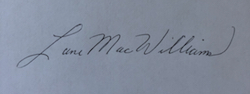
Lane MacWilliams


No comments:
Post a Comment