1. What is your thought regarding current challenges to the First Amendment?
Answer: Given our short term challenges, we are not going to be experiencing First Amendment rights in the immediate future. The public needs to comprehend this, because it relates to their safety. There has been a "turning point" with regard to this and other freedoms to which the American public has become accustomed, and it is critical that the people perceive this shift.
2. What does that mean on a daily basis?
Answer: It means that our leaders are in an extremely challenging position, in which American sovereignty is being severely challenged on a daily basis. And it means that the American people need to pay greater attention to their own words, both in public conversations and ostensible "private" dialogue.
3. Why is "private dialogue" merely ostensible?
Answer: Because nearly all dialogue, public or private, is now being aggregated and analyzed through AI modalities. So, our relationship to "privacy" has changed, although the majority of the public is unaware of this transition.
The prior director of the ODNI, Avril Haines, announced to American public several years ago that their phones were recording both audio and video of their private lives without their knowledge or consent. So this has been transpiring for a number of years without any real understanding of the consequences.
4. How should the American public now speak about our elected and appointed leaders?
Answer: Carefully and with respect. The American public should think of a given leader as a beloved relative who is under terrible pressure to solve intractable problems on a short schedule in order to comprehend the situation properly. It takes great courage to lead at this time, and, while the reasons for this will not be rendered public anytime soon, we need to convey to the public that there are great challenges that exist outside of their view.
I believe deeply in independent voices, and I believe wholeheartedly in freedom of speech in the long term.
But we cannot expect to exercise full First Amendment rights in the immediate term.
We need to comprehend this fact, and we need to adapt.
5. Is this difficult for those of us who have grown up with freedom of speech as a given?
Answer: Extremely so. Many people will have tremendous difficulty in making this change at this time. So we need to try to help one another as much as we can.
6. Will there be an opportunity for the resurgence of free speech in the long term?
Answer: Free speech will become critical for the wellbeing of humanity in the long term, and even the resilience and readiness of society in the medium term, because our circumstances are going to change rapidly in each time period. So we need to attempt to support the United States and our leadership as much as we can with each new critical challenge that arises for us.
7. Are there going to be multiple waves of critical challenges?
Answer: There are, yes. This is a certainty. And I think there will be separate policy spheres to address our changing circumstances. But we will all need to demonstrate an increasing ability to adapt to rapid change, and for many of us, this will be new.
8. Is humanity capable of rapid change?
Answer: We dislike it on the whole, but we are quite capable of it. And we need to remind one another of our fortitude, our determination, and our resilence when we face the unexpected.
9. Will you keep us updated as you are able?
Answer: As much as I am able to help us forward, I will endeavor to do so.
10. Thank you for speaking with us this afternoon.
Answer: You are quite welcome.
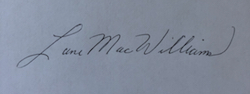
Lane MacWilliams


No comments:
Post a Comment